
Reconstruction & Build-Back in Irvine & South OC
Most restoration companies dry your property and hand you a list of builders to call. We do not. PCH Restoration Team is a California licensed general contractor, CSLB #935386, so the crew that dried your home is the crew that puts it back — drywall, texture, paint, flooring, cabinetry, full rooms.
- Licensed CA Contractor — CSLB #935386
- Mitigation + Rebuild, One Contract
- Texture & Finish Matching
- Family-Run Since 2009
What Build-Back Actually Covers
Restoration reconstruction is the rebuild phase after a water or mold loss: replacing the drywall, insulation, flooring, trim and cabinetry that had to be removed, and finishing it so the repair is invisible. It begins only once the structure has been verified dry, and it is what returns a property to pre-loss condition.
A license you can check. PCH holds California contractor license 935386, verifiable at cslb.ca.gov. It is the one credential in this trade you can independently confirm.
Mitigation and rebuild together. No second contractor to find, no re-tendering once your property is dry, no gap while your home sits open.
We will not close a wet wall. Rebuild starts only after the verification reading confirms every affected material met its drying goal.
The finish is what you live with. Texture and paint matching is where a repair either disappears or announces itself for the next decade.
Where most restoration jobs actually go wrong
Not during the emergency. Not during the drying. The failure point is the handoff — the moment the mitigation company packs up its equipment and the homeowner is told to find a builder.
At that point the property sits open. The new contractor prices from scratch, has no involvement in the decisions already made, and has no reason to trust that the structure behind the open wall is genuinely dry. Meanwhile the insurer is waiting on a rebuild estimate that nobody has produced. Weeks pass, and the homeowner is managing a project they never wanted between two companies who each consider the other’s work someone else’s problem.
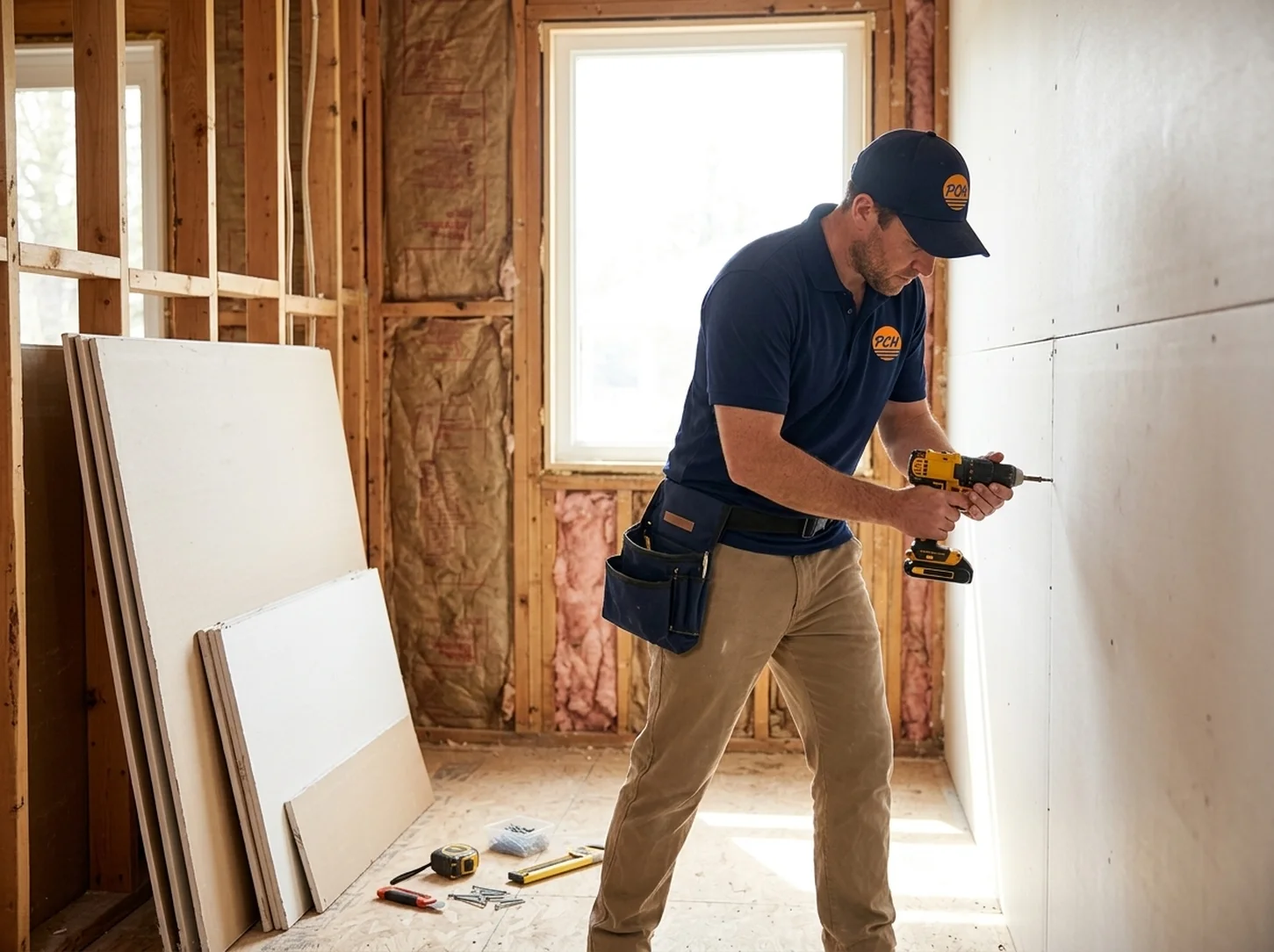
Why a Restoration Company With a GC License Is Different
Most restoration firms hold a mitigation capability but not a general contractor license, so they legally cannot perform the rebuild. That is not a criticism — it is a structural fact about the trade that homeowners usually discover at the worst moment.
With one license
- One contract, one contact — through emergency response, drying, and final paint.
- Mitigation decisions made with the rebuild in mind — where we cut drywall is chosen partly for how cleanly it will be repaired.
- No re-estimating — the rebuild scope is written by people who saw what was behind the wall.
- No gap in the schedule — rebuild follows verification, not a tender process.
- One party accountable — nobody can blame the other company, because there is not one.
What the split usually produces
- The property sits open — often for weeks while a builder is found and quotes.
- Decisions get relitigated — the new contractor questions what was removed and why.
- Nobody owns the moisture — the builder did not dry it and will not warrant it.
- Two estimates that do not reconcile — and an adjuster asking why.
- The homeowner becomes project manager — of a project they did not choose to run.
What We Rebuild
Everything a water or mold loss typically takes out of a property, from a single low band of drywall to a full room. Where a specialist trade is required we bring one in and manage them, rather than pretending the capability is in-house.
Drywall & texture
Board, tape, mud, and texture matched to the existing surface. The most common rebuild item by far, and the one where a poor match is most visible under Orange County’s low winter light.
Paint & finishes
Sealing, priming over any stained substrate, and painting. Taken to a natural break — a corner or a wall line — rather than feathered mid-wall, because a patch always eventually shows.
Flooring
Carpet and pad, laminate, engineered and solid hardwood, vinyl plank, and tile. Includes refinishing hardwood that was successfully dried rather than replaced.
Trim, doors & millwork
Baseboard, casing, crown, and interior doors. Existing profiles matched where the product is still available, or milled to match where it is not.
Cabinetry & counters
Kitchen and bathroom cabinet replacement or repair, plus counters. Toe kicks and cabinet bases are the parts that most often fail after a floor-level loss.
Insulation & ceilings
Replacing insulation removed during mitigation, and full ceiling rebuild after roof or upper-floor losses — including matching older acoustic and knockdown ceilings.
Managed rather than performed in-house: plumbing repair of the failed pipe or fixture, roofing, and electrical beyond reconnection are trades we coordinate. Contents pack-out and storage is subcontracted to a specialist. We say which is which up front, because a contractor who claims everything is a contractor who subcontracts silently.
Where the mitigation scope sets the rebuild scope
How much rebuilding a property needs is decided during mitigation, not during construction. Under the ANSI/IICRC S500 framework, the water’s category determines what could be dried in place and what had to be removed as contaminated, and the class determines how much of the structure was affected at all. A Category 1 loss in a Class 1 area might mean a two-foot band of drywall and new carpet pad. A Category 3 loss across a Class 3 area means insulation, drywall, pad, baseboard, and often cabinetry across several rooms.
That is why we would rather do both halves. When our own crew set the LGR dehumidifiers, took the pin and pinless moisture meter readings, and decided which materials came out, the rebuild estimate is written by people who saw the framing, the sill plate, and the subfloor with their own eyes. A builder quoting from a closed-up room and somebody else’s notes is estimating what is probably behind the drywall — and the variance in that guess is where change orders come from.
It also means the demolition was done with the repair in mind. Where a wall gets cut, whether a cut follows a stud line, whether a ceiling is opened to a natural break or a ragged edge — those are drying decisions with reconstruction consequences, and they are cheaper to get right during mitigation than to correct afterward.
How the Rebuild Runs
Six stages. Stage one is a gate, not a formality — nothing proceeds without the drying verification.
Verification That It Is Dry
Every affected material at or below its drying goal, with a final reading recorded. If another company did the mitigation, we want to see their log or we take our own readings before quoting.
- You get the verification record before rebuild is scheduled
- We will not build over an assembly nobody measured
Scope and Estimate
An itemized rebuild scope, written separately from mitigation so you and your adjuster can see exactly what belongs to which phase. Any upgrade you want is priced as its own line.
- Line-by-line, not a lump sum
- Claim scope and owner-paid upgrades clearly separated
Material Selection and Matching
We identify existing textures, paint sheen and flooring products, and source matches. Where a product is discontinued, you get the options rather than a decision already made on your behalf.
- Texture sampled and test-boarded before it goes on your ceiling
- Discontinued flooring options explained, including patching from a closet
Rough Work
Insulation, drywall, and any framing repair, plus reconnection of electrical or plumbing disturbed during mitigation. Inspections where the work requires them.
- Dust containment and floor protection through occupied areas
- You are told which days will be noisy or dusty in advance
Finish Work
Texture, paint, trim, flooring and cabinetry. This is the slowest-looking phase because of cure and dry times between coats, and rushing it is what produces a repair you can see from the doorway.
- Texture matched, then painted to a natural break
- Trim profiles matched to the existing run
Walkthrough and Close-Out
We walk it with you and write down anything you are not happy with, then finish that list before invoicing. You keep the full documentation — mitigation logs, verification readings, and the rebuild scope.
- Snag list agreed in writing, not verbally
- Complete job record retained for your claim and for resale
What Has To Be True Before We Close a Wall
Every affected material at or below its drying goal, confirmed by a moisture meter and recorded. Not “it looks dry,” not “the equipment ran for four days” — a number per material, measured against an unaffected reference of the same material in the same building.
Under the ANSI/IICRC S500 standard, Fifth Edition 2021, the drying goal is set from a dry reference reading rather than an absolute number, because the correct moisture content for framing in a coastal Dana Point condo is not the same as for framing in a dry inland tract. That reference is what makes the endpoint checkable by somebody who is not us.
| Before we… | What has to be verified | Why it matters |
|---|---|---|
| Hang drywall | Framing, sill plate and sheathing at or below their drying goal on a pin meter. | A sealed cavity with a wet baseplate has no airflow and no way to dry. This is the single most common route back to a mold job. |
| Replace insulation | Cavity surfaces dry and the moisture source confirmed repaired. | New insulation against damp framing absorbs that moisture and holds it out of reach. |
| Lay flooring | Slab or subfloor moisture within the flooring manufacturer’s stated limit. | Concrete releases moisture slowly. Flooring laid over a slab still giving off vapor cups, lifts, or delaminates — and the warranty is void. |
| Refit cabinetry | Wall and floor substrate dry behind and beneath the run. | Toe-kick voids trap moisture invisibly, and particleboard carcasses swell from the base upward. |
| Paint over a stained substrate | The material behind the stain reads dry, not just the surface. | Sealing a damp substrate traps it. The stain returns, and by then it is under new paint. |
Category matters here too. A Category 3 loss — sewage or grossly contaminated water — means affected porous materials were removed rather than dried, so the rebuild scope is larger from the outset and containment may still be standing when we start. A Category 1 loss caught quickly often means little more than a low band of drywall and new pad. Same square footage, very different rebuild.
Matching Finishes in Orange County Housing Stock
A rebuild is judged almost entirely on whether you can tell where it happened. Matching is harder than it sounds, because the county spans five decades of construction and every era has its own textures, profiles and products.
| Era & typical areas | What is hard to match | How we handle it |
|---|---|---|
| 1970s–80s villages — Woodbridge, Northwood, University Park, Turtle Rock | Heavy knockdown and skip-trowel textures, older acoustic ceilings, discontinued trim profiles. | Sample and test-board the texture; mill trim to match where the profile is no longer stocked. |
| 1990s–2000s — Aliso Viejo, Mission Viejo, Foothill Ranch | Orange peel at varying weights, builder paint colors long discontinued. | Match spray weight on a board; color-match from an undisturbed sample rather than a paint chip. |
| 2010s onward — Great Park, Portola Springs, Cypress Village | Smooth level-5 walls that show every imperfection, and wide-plank engineered flooring. | Extra skim and sanding passes; source matching plank runs or take material to a natural break. |
| Coastal — Dana Point, Capistrano Beach, Corona del Mar | Custom and remodeled finishes with no builder standard to work from. | Treat each as bespoke; sample everything and confirm with you before committing. |
When a Restoration Rebuild Needs a Permit
Like-for-like repair generally does not require a permit. Permits typically come into play when framing is altered, when electrical or plumbing is relocated rather than reconnected, or when the work goes beyond restoring pre-loss condition. Requirements vary by jurisdiction across Orange County.
This matters more than it sounds, because unpermitted work that should have been permitted becomes your problem at resale, not the contractor’s. A buyer’s agent finding altered framing with no record can derail a sale years later.
- Usually no permit — replacing drywall, insulation, texture, paint, flooring, trim, and cabinetry like for like.
- Usually a permit — structural framing repair or alteration, moving electrical circuits or plumbing runs, changing a room’s layout or use.
- Check first — work in a condo or HOA, which may also need association architectural approval regardless of what the city requires.
- Code upgrades — when a repair triggers a current-code requirement the original construction did not meet. Some policies include ordinance-or-law coverage for exactly this; many do not.
As a licensed contractor we tell you which category your job falls into before work starts. If a permit is needed we pull it. If somebody tells you a structural alteration does not need one, that should end the conversation with them.
Improving Things While the Wall Is Already Open
Your policy covers restoration to pre-loss condition, not improvement. But the wall is open, the floor is up, and the labor is already mobilized — which makes this a genuinely efficient moment to change something you were going to change anyway.
The rule we work to is simple: the claim scope restores what you had, and anything beyond that is quoted separately and paid directly by you. Keeping those two things visibly apart protects you if an adjuster later queries the scope, and it means you always know what insurance actually paid for.
- Flooring upgrades — the most common. If the room is stripped anyway, moving from carpet to hardwood costs the difference in material and finish rather than a full project.
- Cabinetry and fixtures — when a kitchen or bathroom is already partly out, upgrading the remainder avoids doing it twice.
- Insulation improvements — an open wall is the only easy chance to improve insulation, and it is inexpensive at that moment.
- Electrical additions — extra outlets or lighting while the cavity is accessible, permitted where required.
- Removing an old acoustic ceiling — frequently worth doing while ceiling work is already underway, since containment and protection are already in place.
Rebuilds With an Association Involved
In a condo or HOA the construction is rarely the complication. The complication is that a common-area repair and an owner’s interior repair may be funded by different parties, so the scopes have to be separable from the start.
We scope them apart: what belongs to the association’s responsibility under California Civil Code §4775 and the CC&Rs, and what belongs to the owner. That way a board can approve its portion without inheriting the owner’s finishes, and an owner can upgrade their own interior without arguing about who authorized it.
For boards and managers
- Association-scope work priced and documented separately
- Common-area finishes matched across affected units
- Architectural approval requirements identified before work starts
- One contractor across mitigation and rebuild — see HOA services
For unit owners
- Your interior scope, clearly yours, and clearly priced
- Upgrades available without touching the association scope
- Documentation you can send to your own carrier
- One point of contact instead of chasing a board and a builder
How the Rebuild Sits Inside Your Claim
Mitigation and reconstruction are usually separate lines on a claim. Mitigation covers the emergency response and drying; reconstruction covers restoring the property to pre-loss condition. Because we do both, you get one itemized scope with the two clearly separated — which is also the format adjusters prefer.
The most common friction on a rebuild scope is matching. A policy restores pre-loss condition, so where a discontinued product means an undamaged adjacent area must also be replaced to achieve a reasonable match, that is a conversation worth having with your adjuster early rather than after the flooring is ordered.
What we do
- Itemize line by line — so every element can be reviewed rather than argued about as a lump sum.
- Separate claim scope from owner-paid upgrades — visibly, in the document.
- Carry the documentation through — mitigation logs and verification readings support the rebuild scope, because we produced both.
What we do not
- Promise what your carrier will pay — including on matching, which is policy-specific.
- Bury upgrades inside the claim scope — that is misrepresentation, and it is your claim it damages.
- Start rebuild without verification — no schedule pressure, from anyone, changes that.
Broader questions on deductibles, supplements and denials are on our full FAQ page.
Reconstruction Questions, Answered
Mostly asked once the drying equipment has gone and the question becomes how long the house stays like this.
Why does it matter that the same company dries and rebuilds?
Because the handoff between two companies is where restoration jobs stall. A separate builder inherits decisions they did not make, has no reason to trust the drying, and starts their own estimate and schedule. One license means one scope, one contact, and no gap where your home sits open.
Can you match my existing ceiling texture?
In most cases yes, and it is the part people judge the whole job by. Orange County has decades of different textures — knockdown, orange peel, skip trowel, and older acoustic ceilings. We sample the existing finish and test on a board before touching the ceiling.
What if my flooring is discontinued?
It happens constantly, particularly with 10 to 20 year old products. The options are sourcing remaining stock, taking material from a closet or under an appliance to patch the visible area, or replacing to a natural break such as a doorway. We will show you the options rather than deciding for you.
Does the rebuild need permits?
Like-for-like repair of drywall, paint and flooring generally does not. Permits typically come into it when structural framing is altered, when electrical or plumbing is relocated rather than reconnected, or when the work goes beyond restoring pre-loss condition. As a licensed contractor we tell you which applies.
Can I upgrade finishes while the wall is already open?
Yes, and it is often the sensible moment. Your policy covers restoration to pre-loss condition, so an upgrade is a separate item you pay for directly. We quote it separately from the claim scope so there is no confusion about what insurance covered.
How long does reconstruction take?
A single-room drywall, texture, paint and baseboard rebuild often runs about one to two weeks including cure times. Kitchens, bathrooms, and anything involving cabinetry or flooring across several rooms take longer, mostly because of lead times on materials rather than labor.
Do you start the rebuild before the drying is finished?
No. Nothing gets closed up until every affected material meets its drying goal and we have the verification reading. The US EPA advises drying water-damaged materials within 24 to 48 hours, and a sealed wet cavity fails that permanently — which is the single most common way a restoration becomes a mold remediation six months later.
How do I verify your license?
Search license number 935386 at cslb.ca.gov. That shows the status, classification, bond and workers compensation. We would encourage you to check any contractor that way, including us — it takes a minute and it is the only credential in this trade you can independently confirm.
Who pays for the rebuild, and is it separate from mitigation?
They are separate lines on most claims. Mitigation covers emergency work and drying; reconstruction covers putting the property back. Because we do both, you receive one itemized scope with the two clearly separated, which is also what an adjuster wants to see.
What about condo and HOA rebuilds?
We handle those regularly. The complication is rarely construction; it is that a common-area repair and an owner’s interior repair may be funded differently. We scope them separately so the association and the owner can each see what belongs to them.
Ready To Put It Back?
One licensed company from the emergency call to the final coat of paint — or just the rebuild, if someone else dried it and left.