
Mold Remediation in Irvine & South OC
Containment first, moisture source corrected, affected materials removed — then cleared by an independent third party rather than by us. PCH Restoration Team works to the ANSI/IICRC S520 standard for mold remediation and holds California contractor license CSLB #935386, so the same company can rebuild what came out.
- Independent Third-Party Clearance
- Scoped to IICRC S520
- Licensed CA Contractor — CSLB #935386
- Remediation + Rebuild, One Team
What Mold Remediation Actually Involves
Mold remediation is the controlled removal of mold-affected materials from a building, plus correction of the moisture that fed the growth. It is not cleaning and it is not spraying. Done properly it means sealed containment under negative air pressure, HEPA filtration, removal of porous materials that cannot be decontaminated, and verification by testing after the work.
There is a written standard. Professional mold remediation is governed by the ANSI/IICRC S520 standard. We reference it as the methodology our scopes are written to — not as a certification we hold.
Mold is a water problem first. The US EPA advises drying water-damaged areas and items within 24–48 hours to prevent mold growth.
We do not clear our own work. Clearance sampling is coordinated through an inspector with no financial stake in the result. If it fails, we return at our cost.
Nobody can guarantee mold never returns. It regrows wherever moisture does. Any company promising otherwise is selling something it cannot deliver.
Remediation is not the same as removal
You will see “mold removal” advertised as though a building can be made sterile. It cannot. Mold spores exist in outdoor air everywhere, including all over Orange County, and they will always be present indoors at some background level. The realistic and industry-accepted goal is to return the indoor environment to a condition comparable to the outdoor baseline and to unaffected areas of the same building — which is exactly what a clearance sample measures.
That framing matters because it tells you what to demand. Not “is it gone forever,” which nobody can answer, but “is this room now comparable to the rest of the house, and who measured that.”
Why We Refuse To Clear Our Own Mold Work
Clearance testing is supposed to be an independent check that the remediation worked. When the company that did the removal also takes and interprets the sample, that check is not independent — it is the contractor grading its own homework. We coordinate clearance through a third-party inspector instead.
Post-remediation verification is normally performed by an inspector who is independent of the remediation contractor, taking air and surface samples before containment comes down and comparing them against an outdoor baseline and an unaffected indoor area. The separation is the entire point of the exercise. It is also what most insurance carriers and every HOA board attorney will expect to see in the file.
This is a commercially inconvenient position for us. Self-certifying is faster, cheaper, and nobody usually asks. We do it the other way because a mold clearance letter is worthless the moment the person who wrote it had a reason to want it to pass.
How we handle clearance
- Independent sampling — coordinated through a third-party inspector with no stake in whether the job passes.
- Sampled before containment comes down — testing after the barriers are gone tells you very little.
- Compared to a baseline — outdoor air and an unaffected indoor area, not an arbitrary number.
- We go back if it fails — at our cost. That is what makes independence meaningful rather than decorative.
What we will not do
- Write our own clearance letter — the conflict of interest is obvious and it devalues the document.
- Promise a mold-free home — spores are in outdoor air everywhere. The honest goal is a normal indoor baseline.
- Sell testing you do not need — visible mold with an obvious cause usually needs removal, not a lab bill first.
- Fog and leave — spraying an antimicrobial over affected porous material without removing it is cosmetic.
What Indoor Mold Actually Does To People
The Institute of Medicine found sufficient evidence linking indoor mold exposure to upper respiratory symptoms, cough, and wheeze in otherwise healthy people, and to worsened symptoms in people who already have asthma. Reactions vary widely — some people in the same house feel nothing at all.
According to CDC guidance on mold, exposure to damp and moldy environments may cause a range of effects, or none. People with asthma or a mold allergy can have severe reactions. Immune-compromised people and those with chronic lung disease can develop lung infections. Some research also suggests a link between early mold exposure and the development of asthma in genetically susceptible children.
We are a restoration contractor, not a medical practice, so we will not tell you what your symptoms mean — that is a conversation for your doctor. What we will do is deal with the building. If someone in the household has asthma, a mold allergy, a compromised immune system, or chronic lung disease, tell us at the assessment. It changes how we schedule containment, whether we recommend the household relocates during the work, and how conservative we are about what comes out.
How a PCH Mold Remediation Job Runs
Seven stages, in this order. The order is not negotiable — containment before demolition, and moisture correction before rebuild, or the job fails.
Assessment and Moisture Source
We find the water before we touch the mold. Moisture meters, thermal imaging, and where needed a borescope to see inside a cavity. Mold is a symptom, and remediating without correcting the source guarantees a repeat.
- You will see us checking rooms that look fine — moisture travels
- You get a written scope of what is affected and why
Containment
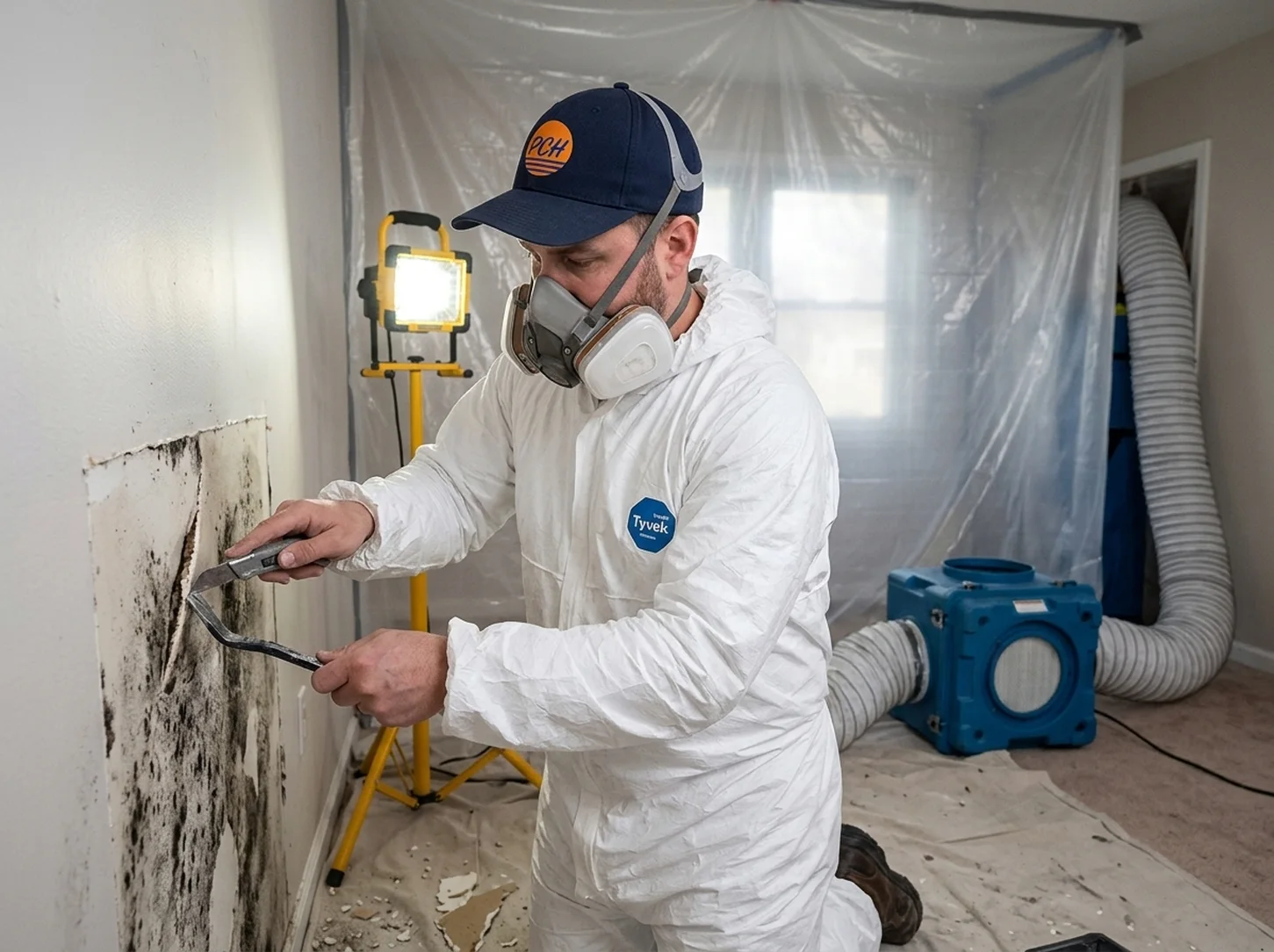
Sealed polyethylene barriers around the work area, with a negative-air machine running so air flows into the containment and never out of it. The exhaust is HEPA filtered. This is what keeps spores out of the rest of your home during demolition.
- You will see plastic walls, zippered doorways, and taped floor protection
- HVAC serving the area is shut down or sealed so it cannot distribute spores
Controlled Removal
Affected porous materials come out — drywall, insulation, carpet pad, and any wood too degraded to clean. Cuts are made back to a defined margin beyond visible growth, and debris is bagged inside containment before it travels.
- You will see cuts extending past what you can see — that margin is deliberate
- Nothing dusty leaves the containment unbagged
HEPA Cleaning and Treatment
Remaining structure is HEPA vacuumed and wiped down. Where an antimicrobial is appropriate it is applied to cleaned, non-porous surfaces — as a finishing step on material we have already remediated, never as a substitute for removing material that should have come out.
- You will see repeated vacuum and wipe passes, including framing and cavities
- Air scrubbers keep running through this stage
Drying to a Verified Target
The cavity and framing have to be dry before anything is closed up. LGR dehumidifiers and air movers run to a written drying plan with daily moisture readings, because sealing a wet wall is how a remediated room becomes a remediation job again.
- You get daily documented moisture readings
- Equipment leaves when the meter says dry, not on a schedule
Independent Clearance Testing
A third-party inspector samples while containment is still standing, and compares results against an outdoor baseline and an unaffected indoor area. We do not take, interpret, or sign off on this sample.
- You receive the inspector’s report, not our summary of it
- If it fails, we re-clean and re-test at our cost
Rebuild
Once clearance passes, containment comes down and we put the room back — drywall, texture, paint, trim, flooring — under our own general contractor license. One company, one scope, no handoff to a second contractor.
- You get an itemized rebuild scope
- Finishes matched to the existing room wherever possible
What Containment Actually Requires
Three systems do the work: containment holds the work area apart from the rest of the building, filtration captures what demolition releases, and detection finds the moisture that started it.
Containment
Sealed polyethylene barriers, zippered entry, and negative-air machines that keep the work zone at lower pressure than the surrounding space, so airflow runs inward. Critical barriers seal HVAC registers and returns so the system cannot carry spores to other rooms.
Filtration
HEPA air scrubbers running through demolition and cleaning, HEPA vacuums for surfaces, framing, and cavities, and HEPA-filtered exhaust on the negative-air machines. HEPA is the specification that matters, because ordinary filtration does not capture particles at the relevant size.
Detection & drying
Pin and pinless moisture meters, thermo-hygrometers, thermal imaging to reveal temperature differences that suggest hidden moisture, and borescopes to inspect inside a cavity before opening it. Then LGR dehumidifiers and air movers to bring materials to a verified dry reading.
Why Mold Grows in South Orange County Homes
People assume a dry Southern California climate means no mold problem. The opposite is closer to the truth: moisture here is chronic and hidden rather than dramatic and seasonal, so it runs for months before anyone notices a smell.
- Slab leaks in the original-copper villages — Irvine’s 1970s and 80s villages such as Woodbridge, Northwood, University Park, and Turtle Rock were built slab-on-grade with copper supply lines. A pinhole leak under the slab wicks up through the baseplate into drywall and can run for months with no visible water at all.
- HVAC condensate lines — a blocked or disconnected condensate drain leaks quietly inside a ceiling or wall cavity. This is the single most common way we get called for mold rather than water, because there was never a puddle to see.
- The marine layer — coastal communities from Corona del Mar through Newport Coast, Dana Point, and Capistrano Beach sit under persistent morning humidity. Poorly ventilated bathrooms and closets on the ocean side stay damp long enough to grow surface mold without any leak at all.
- Wind-driven rain at windows and roof penetrations — our rain arrives in short, intense winter storms. Water enters at a flashing or window head, disappears into the wall, and shows up as a stain weeks later. See roof leak water damage.
- Shared walls in condos and HOA buildings — a supply failure in one unit becomes a neighbor’s mold problem through a shared cavity. Common in the dense condo stock around Laguna Woods Village, Aliso Viejo, and Mission Viejo.
- Water losses that were dried badly — the most preventable cause we see. Somebody extracted the visible water, skipped verification, and closed the wall while the baseplate was still wet.
If You Have Just Found Mold
The instinct is to clean it immediately. Resist that. Disturbing mold without containment is the one action that reliably turns a contained problem into a whole-house problem.
Do this
- Leave it alone — every scrub, scrape, or wipe aerosolizes spores into air the rest of the house shares.
- Photograph it before anything changes — wide shot and close-up, for your claim file and so we can see its original extent.
- Stop the water if you can find it — a running toilet valve, a dripping supply line, a blocked condensate drain.
- Close the door to the room — a closed door is crude containment, and crude is better than none.
- Turn off HVAC serving that area — a running system will move spores through the ducts into rooms with no problem at all.
- Tell us about anyone vulnerable — asthma, mold allergy, immune-compromised, infants, elderly. It changes our plan.
Do not do this
- Do not bleach it — bleach is mostly water, so on porous material it adds moisture while only decolorizing the surface. It looks fixed and is not.
- Do not point a fan at it — you will distribute spores through the house. This is the most common well-meaning mistake we see.
- Do not tear out drywall yourself — uncontained demolition is exactly what containment exists to prevent.
- Do not paint over it — including with “mold-blocking” primer. It hides the evidence and keeps growing underneath.
- Do not buy a home test kit and act on it — settle plates grow something from almost any indoor air, and the result rarely changes the correct action.
- Do not accept a clearance from the company that did the removal — including from us.
What Gets Removed, and What Gets Saved
The dividing line is porosity. Materials with open structure absorb mold into themselves and cannot be reliably cleaned, so they come out. Dense, non-porous materials can usually be cleaned in place and kept.
| Material | Usual outcome | Why |
|---|---|---|
| Drywall | Removed | Paper facing and gypsum core are porous and hold growth through their thickness. Cut back past visible growth to a defined margin. |
| Insulation | Removed | Fibrous and open. It cannot be cleaned, and wet insulation loses R-value permanently anyway. |
| Carpet pad | Removed | Open cell structure that holds both moisture and growth. Inexpensive to replace, never worth saving. |
| Carpet | Depends | Sometimes salvageable after clean water, but not once growth is established in the backing or the water was contaminated. |
| Framing & sill plate | Usually cleaned | Dense enough to HEPA vacuum, wipe, and sometimes sand. Removed only where the wood is structurally degraded. |
| Concrete, tile, glass, metal | Cleaned | Non-porous. Growth sits on the surface and comes off with HEPA vacuuming and wiping. |
| Cabinetry & millwork | Depends | Solid wood often cleans up; particleboard and MDF swell and delaminate, and are treated as porous. |
We will always tell you which side of that line something falls on and why. If we think a cabinet run can be cleaned and dried rather than replaced, we will say so — even though replacing it would be worth more to us.
What Mold Remediation Costs, Honestly
Mold remediation is priced by the size of the containment, how much material has to come out, and how hard the affected area is to reach. A single bathroom wall and a whole-floor cavity job are different orders of magnitude, and no honest company quotes either without seeing it.
Four things drive the number more than anything else:
- Containment size and complexity — one room with a door is straightforward; an open-plan area or a multi-level cavity needs far more barrier and more air machines.
- How much porous material is affected — drywall, insulation, and pad are cheap to buy and expensive to remove correctly under containment.
- Access — mold behind a tiled shower, inside a soffit, under cabinetry, or in a crawl space costs more to reach than mold on an open wall.
- Whether the moisture source is fixed — if a plumber or roofer has to come first, that is a separate trade and a separate cost, and it has to happen before we close anything up.
Mold and Your Policy
Mold coverage is narrower than water coverage and usually capped. Mold resulting from a sudden, covered water loss is more often considered; mold from a long-running leak, humidity, or deferred maintenance is commonly excluded. Many California policies carry a specific mold sublimit. Check your policy and your limit.
This is the single biggest source of unpleasant surprises in our trade. A homeowner assumes water damage cover extends to the mold that followed, then discovers a sublimit that covers a fraction of the job. We would rather you learn that from us at the assessment than from an adjuster three weeks in.
What we do
- Document the cause — photos, moisture readings, and where possible evidence of whether this was sudden or long-running, because that distinction drives the coverage decision.
- Provide the independent clearance report — third-party documentation carries more weight in a claim file than a contractor’s own sign-off.
- Write a clear itemized scope — containment, removal, cleaning, drying, and rebuild separated out.
What we do not
- Promise mold coverage — no contractor can tell you what your carrier will pay, and mold is where policies are most restrictive.
- Characterize a long-term leak as sudden — we document what we find. Misrepresenting cause of loss is fraud, and it is your name on the claim.
- Wait on an adjuster before containing — containment limits spread, and spread expands the eventual scope.
Deeper policy questions — sublimits, supplements, denial reasons — are covered on our full FAQ page.
Mold Remediation Questions, Answered
The questions homeowners, buyers, and HOA boards actually ask us — including the ones with uncomfortable answers.
Why should the company that removes the mold not be the one that clears it?
Because grading your own homework is not proof. Clearance testing is meant to be an independent check that the work succeeded, so we coordinate it through a third-party inspector who has no financial interest in the outcome. If the sample fails, we go back in at our cost.
Can you guarantee the mold will never come back?
No honest contractor can, and you should be cautious of one who does. Mold regrows wherever moisture returns. What we can do is remove the affected materials, correct the moisture source that fed it, and verify the result with independent testing.
Is bleach a real fix for mold?
Not on porous materials. Bleach is mostly water, so on drywall or framing it can wet the material further while only decolorizing what you see on the surface. The EPA does not recommend routine biocide use for mold cleanup; removing the material and fixing the moisture is the fix.
Do I have to move out during mold remediation?
Usually not. Containment is built to isolate the work area under negative pressure so the rest of the home stays usable. Households with asthma, mold allergy, immune-compromised members, or infants may prefer to stay elsewhere while the work runs.
How do you stop mold spreading to the rest of the house?
Sealed containment barriers plus negative air pressure, so air flows into the work zone and never out of it, with the exhaust HEPA filtered. Nothing dusty leaves the containment unbagged, and the area is HEPA vacuumed and wiped before testing.
What standard do you work to?
The ANSI/IICRC S520 standard for professional mold remediation, alongside S500 for the water damage that usually caused it. We reference these as the methodology our scopes are written to. PCH holds California contractor license CSLB #935386.
Does homeowners insurance cover mold?
Sometimes, and usually with a cap. Mold that results from a sudden covered water loss is more often considered than mold from a long-term leak or deferred maintenance, and many California policies carry a specific mold sublimit. Check your policy and your limit before assuming.
How long does mold remediation take?
A contained single-room job commonly runs two to four days for removal and drying, plus turnaround for the independent clearance sample. Larger jobs and anything involving cavity work or HVAC take longer. Rebuild is scheduled after clearance passes.
Why does mold keep coming back in the same spot?
Because the moisture source was never corrected. Recurring mold in one location is a plumbing, roofing, envelope, or condensation problem wearing a mold costume. We look for the source first, since remediation without correction is a temporary cosmetic result.
Do I need testing before remediation, or just after?
If mold is visible and the cause is obvious, pre-testing often adds cost without changing the scope. Testing earns its keep when the problem is hidden, when occupants have symptoms, or when a buyer, seller, board, or insurer needs documentation — see mold inspection. Clearance testing afterward is the one we insist on.
Smell Something, or See Something?
We will look, tell you honestly whether it needs remediation, and if it does, clear it through an inspector who does not work for us.