
24/7 Emergency Water Removal in Irvine & South OC
Standing water right now? Call 949-617-1111. A person answers around the clock and the nearest available crew is routed to you with truck-mounted and portable extraction on board. We stop the source, pull the water, and set drying equipment on the same visit — then rebuild what had to come out under our own contractor license, CSLB #935386.
- Licensed CA Contractor — CSLB #935386
- Live 24/7 Dispatch, Not a Call Center
- Extraction + Rebuild, One Team
- Daily Documented Moisture Logs
What Emergency Water Removal Actually Is
Emergency water removal is the same-day extraction of standing water from a building, followed immediately by the drying setup that stops the damage spreading. It is the first phase of restoration, not the whole job. The US Environmental Protection Agency advises drying water-damaged areas and items within 24 to 48 hours to prevent mold growth, which is why the hours after a loss decide its size.
The clock is real. The EPA’s Brief Guide to Mold, Moisture and Your Home states it is important to dry water-damaged areas and items within 24–48 hours to prevent mold growth.
Clean water does not stay clean. Under the ANSI/IICRC S500 framework, Category 1 water degrades toward Category 2 after roughly 24–48 hours of dwell time, which changes both the handling and the bill.
The most common claim there is. Water damage and freezing accounted for 27.6% of homeowners insurance claims in 2022, averaging $13,954 paid (Insurance Information Institute).
South OC has almost no basements. Most local homes are slab-on-grade, so water travels sideways and wicks upward rather than pooling — which is why mapping matters more here than pumping.
Extraction is phase one, not the finish line
Getting the visible water out is the part everyone can see, and it is the part homeowners assume is the whole job. It is not. Once the standing water is gone, the structure around it is still holding moisture — inside wall cavities, under the flooring, in the baseplates bolted to the slab, and in the insulation you cannot see.
That trapped water is what decides whether your materials are saved or demolished. A crew that extracts and leaves has done maybe a third of the work. Extraction, metered drying, and verification are one continuous job, and on our contracts they are handled by one company from the first call through the last coat of paint.
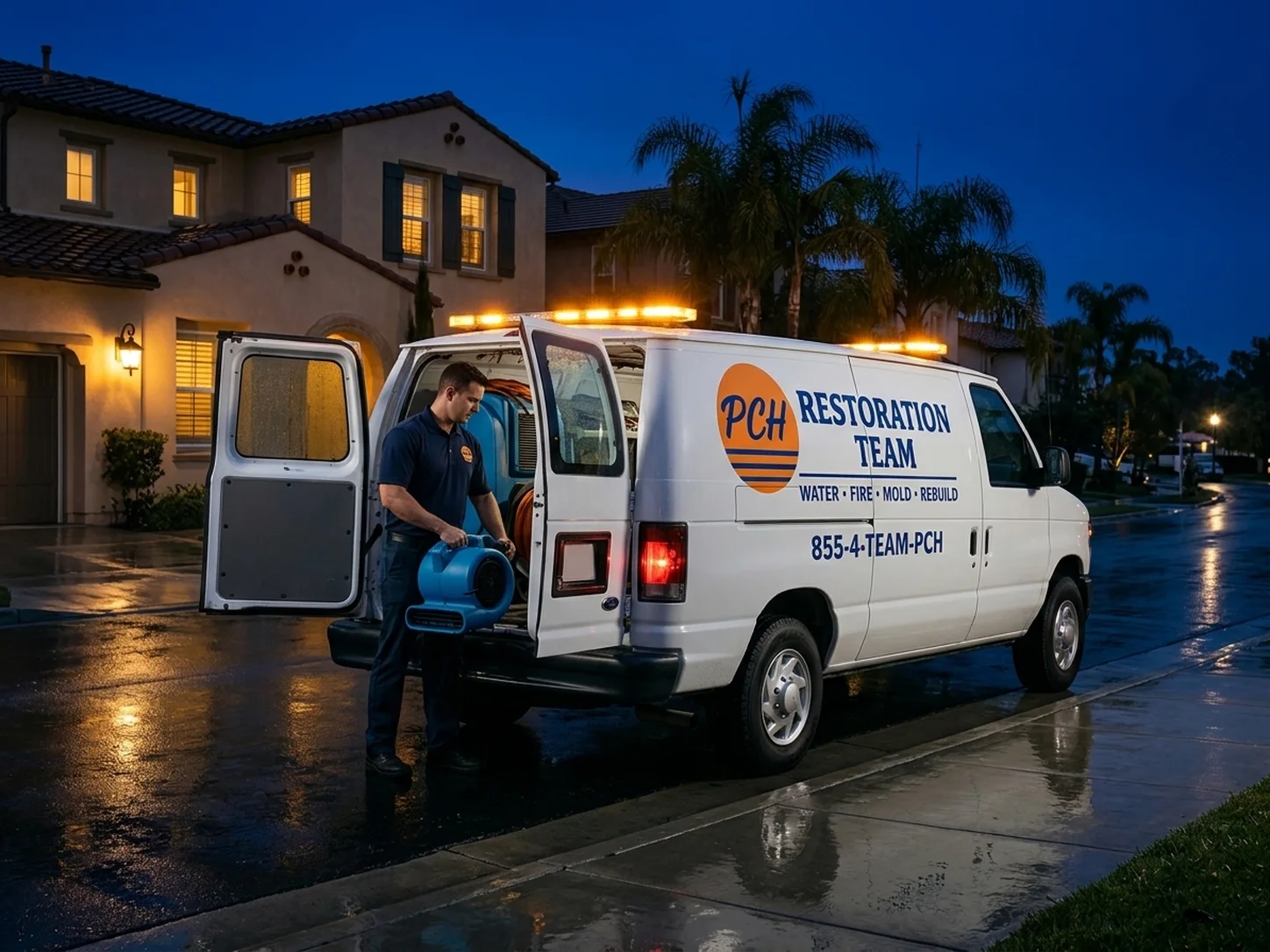
What To Do — and What Not To Do — in the First Hour
Protect people first, your insurance claim second, and your property third. Everything below can be done safely by a homeowner while a crew is on the way. If any step requires standing in water to reach electricity, skip it and wait for us.
Do this now
- Shut off the water at its source — if you can reach it safely. In most South OC homes the main valve is on an exterior wall near the garage, the front hose bib, or the laundry.
- Cut power to the affected circuits — if water is near outlets, appliances, or ceiling fixtures, and only if the panel is dry and safely reachable.
- Photograph everything before you move it — wide shots of each room, then close-ups of the source and the damage. This is the single most valuable thing you can do for your claim, and almost nobody tells you to.
- Get people and pets clear — keep children and animals out of standing water until the water’s category is known.
- Lift and prop what you can — stand upholstery cushions on end, slide foil or wood blocks under furniture legs, and move documents and electronics to a dry room.
- Blot and mop the surface — towels and a mop on hard flooring genuinely help. Every gallon you remove is a gallon that is not soaking into the baseplate.
Do not do this
- Do not walk into standing water near live electricity — if you cannot cut the power without entering the water, stay out and wait for the crew.
- Do not use a household vacuum on water — it can shock you and it will destroy the vacuum. A wet/dry shop vac is the only safe option.
- Do not leave books, magazines, or colored items on wet carpet — dyes transfer into the fibres within hours and the staining is usually permanent.
- Do not run ceiling lights or fans if the ceiling is wet — a saturated ceiling around a fixture is an electrical hazard and a collapse risk.
- Do not wait for your insurer to approve mitigation — most policies expect you to prevent further damage. Delay tends to hurt a claim, not protect it.
- Do not assume it will dry on its own — open windows in coastal Orange County can raise indoor humidity rather than lower it, depending on the marine layer.
What Changes Between Hour One and Day Three
Water damage is not a fixed amount of damage waiting to be cleaned up. It grows. Materials absorb, contamination escalates, and the scope of what has to be removed widens with every hour the structure stays wet.
Drywall wicks moisture upward against gravity, so a floor-level spill routinely leaves a wet band a foot or more up the wall. Water tracks along the underside of subfloor and follows framing into rooms that never got touched. Laminate swells at the seams and delaminates. Engineered wood cups. Carpet pad holds water like a sponge long after the surface feels dry to a bare foot.
The escalation that costs the most is not physical, though — it is biological and it is categorical. Under the ANSI/IICRC S500 standard, water is graded by contamination, and clean Category 1 water degrades toward Category 2 after roughly a day or two sitting in building materials. Once that happens, materials that could have been dried in place often have to be removed instead.
24–48 hours
The EPA advises drying water-damaged areas and items within 24 to 48 hours to prevent mold growth.
Source: US EPA, A Brief Guide to Mold, Moisture and Your Home27.6% of claims
Water damage and freezing made up 27.6% of homeowners insurance claims in 2022, with an average paid claim of $13,954 across 2018–2022.
Source: Insurance Information InstituteFifth Edition, 2021
ANSI/IICRC S500 is the consensus standard describing the procedures and precautions for professional water damage restoration. It is the methodology our drying plans are written to.
Source: IICRC, ANSI/IICRC S500 (2021)$25,000 per inch
FEMA puts the damage from just one inch of floodwater at more than $25,000 — a useful benchmark for how little water it takes to become expensive.
Source: FEMA / National Flood Insurance ProgramWhat Happens After You Call PCH
Six steps, all of them starting on the first visit. You will know what was affected, what is being dried, and what happens next before the crew leaves your property.
A Local Person Answers — 24/7
We ask what happened, whether water is still flowing, what rooms are affected, and whether anyone is at risk. Then we route the nearest available crew and start talking you through damage control while they drive.
- You speak to someone who can dispatch, not a message service
- You get first-hour instructions on the call
Arrival, Already Equipped
Our vans carry extraction units, LGR dehumidifiers, axial air movers, moisture meters, and thermal imaging. The job starts on arrival rather than after a second trip for equipment.
- You will see the crew walk the affected rooms with a meter before touching anything
- You will be asked where the water started, not just where it ended up
Source Control and Safety Check
We confirm the source is stopped, check for electrical hazard around wet outlets and fixtures, and assess the water’s category before anyone works in it.
- You will hear us name the category — and what it means for what can stay
- Contaminated losses get containment and protective equipment from the start
Extraction
Standing water comes out first with truck-mounted or portable extraction, then weighted extraction passes pull water held in carpet and pad. Removing water mechanically is many times faster than evaporating it, so this is where the drying time is won.
- You will see repeated slow passes over the same carpet — that is deliberate
- Pad is usually removed; carpet often stays and is dried in place
Moisture Mapping
Pin and pinless meters plus thermal imaging show where water actually travelled — up walls, under flooring, across room boundaries, into the baseplate. We record a starting reading for every affected material.
- You will see pencil marks or tape where the wet line stops inside a wall
- Nothing damp gets sealed up and forgotten
Drying Setup and Documentation
Dehumidifiers and air movers are placed to a written plan on the same visit, and we return to take daily readings until the structural drying goal is verifiably met — not until a set number of days has passed.
- You get daily moisture logs you can hand to an adjuster
- Equipment leaves when the meter says dry, not when the calendar does
What We Actually Bring, and Why
Three families of equipment do the work: extraction pulls liquid water out mechanically, drying equipment removes what is left as vapour, and detection equipment proves where the water went and when it is gone.
Extraction
Truck-mounted and portable extraction units for standing water, submersible pumps where water is deep enough to pump, and weighted extraction tools that press water out of carpet and pad. Mechanical removal is always cheaper and faster than evaporation, so we extract as much as physically possible before drying starts.
Drying
Low-grain refrigerant (LGR) dehumidifiers to pull moisture out of the air, axial and centrifugal air movers to break the boundary layer of still air sitting against wet materials, and inject-dry systems that push airflow into wall cavities and under hardwood without removing the finish.
Detection
Pin and pinless moisture meters for material readings, thermo-hygrometers for the air, thermal imaging cameras to reveal temperature differences that suggest hidden moisture, and borescopes to see inside a cavity before deciding whether to open it.
Water Categories and Classes, in Plain English
The ANSI/IICRC S500 standard grades a water loss two ways: by category, meaning how contaminated the water is, and by class, meaning how much material got wet and how hard it will be to dry. Category decides your health risk and what must be thrown away. Class decides how much equipment your job needs and how long it stays.
Category — how dirty the water is
| Category | Where it comes from | Health risk | What it means for your materials |
|---|---|---|---|
| Category 1 Clean water | A sanitary source — supply lines, a burst copper pipe, a water heater, an overflowing tub with nothing in it. | No substantial risk from skin contact, swallowing, or breathing at the point of release. | Most materials can be dried in place if we reach them quickly. Carpet is often saved; pad usually is not. |
| Category 2 Grey water | Significant contamination — dishwasher and washing-machine discharge, toilet overflow with urine only, or Category 1 water that has sat and degraded. | Can cause discomfort or sickness if contacted or swallowed. | Porous materials such as pad and often drywall come out. Hard surfaces are cleaned and sanitized, then dried. |
| Category 3 Black water | Grossly contaminated — sewage, a toilet backflow from beyond the trap, rising surface water, or long-standing water that has gone septic. | May contain pathogenic, toxigenic, or otherwise harmful agents. | Containment, protective equipment, and removal of affected porous materials. This is not a do-it-yourself situation. |
Class — how much got wet
Class is about evaporation load. It is the honest answer to “why does my neighbor’s job need four machines and mine needs eleven?”
| Class | What it describes, and what it means for your drying plan |
|---|---|
| Class 1 | The least water and the least absorption — a small area, mostly low-porosity materials. Fewest machines, shortest plan. |
| Class 2 | A whole room or more, with carpet and pad wet and moisture wicking up the walls. A typical residential burst-supply-line loss. |
| Class 3 | Water came from overhead, so ceilings, walls, insulation, and flooring are all wet. The heaviest evaporation load and the most equipment. |
| Class 4 | Specialty drying — moisture held deep in low-permeance materials such as hardwood, plaster, concrete, or stone. Needs longer drying and often inject-dry systems. |
The Emergencies We See Most in South Orange County
Local building stock shapes the call list. Irvine’s older villages were built in the 1970s and 80s on slab-on-grade foundations with original copper supply lines, which produces a very different emergency mix than a region of basements and freezing winters.
- Burst or failed supply lines — braided connectors under sinks, toilet supply lines, and washing-machine hoses. The most common single cause we are called for, and the most preventable.
- Slab leaks — a supply line failing beneath the concrete slab. Warm spots on the floor, water seeping from the base of a wall, or a water bill that jumps for no reason. Common in Irvine’s original-copper villages such as Woodbridge, Northwood, and University Park.
- Water heater failure — a ruptured tank releases dozens of gallons quickly, usually into a garage or an interior closet that shares walls with living space.
- Appliance and fixture overflows — dishwashers, washing machines, tubs, and toilets. Often Category 2 from the moment it starts.
- Roof and window intrusion during storms — wind-driven rain finding its way in, showing as a spreading ceiling stain or an actively dripping light fixture. See roof leak water damage repair.
- HVAC condensate line blockage — a slow, quiet leak that often runs for weeks inside a ceiling or wall before anyone sees a stain, which is why these so often arrive as a mold call rather than a water call.
Where your situation goes next
Emergency extraction is the front door. Depending on what we find, the job continues into one of these:
Full restoration
Extraction, drying, and licensed rebuild handled end to end by one company.
Water damage restoration in IrvineStructural drying
Metered, documented drying when the structure is wet but little has to be removed.
Structural drying servicesMold remediation
When water sat long enough to grow something — always paired with independent third-party testing.
Mold remediation servicesRebuild and repairs
Drywall, texture, paint, flooring, and cabinetry under our own contractor license.
Reconstruction & build-backHomes, HOAs, and Commercial Property
An emergency in a single-family home and an emergency in a 40-unit condo building are different jobs with different paperwork, even when the burst line looks identical. We run both.
Homes and condos
Single-family houses, condos, townhomes, and the individual units inside an association. The priority is your family’s safety, then the smallest honest scope that gets your home dry.
- Same-visit extraction and drying setup
- Contents moved and protected as we work
- Daily moisture logs for your claim file
- Rebuild by the same licensed team
HOAs, property managers, and commercial
Roughly a decade of our work has been HOA and condo water damage, which is as much a documentation problem as a drying problem. When water crosses a demising wall, someone has to establish what is common area and what is the owner’s — and boards make that call from the report you hand them.
- Multi-unit coordination and per-unit documentation
- Reporting a board can act on, with photos and readings by unit
- After-hours work to limit disruption to residents or trading
- Familiarity with California Civil Code §4775 maintenance-responsibility questions
Health and safety while water is still in the building
Standing water carries three risks worth taking seriously. Electrical hazard is the immediate one: water in contact with outlets, appliances, or ceiling fixtures can energise a room, which is why cutting the affected circuits comes before anything else. Contamination is the second — Category 3 water may contain pathogenic or toxigenic agents, and it needs protective equipment rather than a mop and optimism.
The third is slower. The Institute of Medicine found sufficient evidence linking indoor mold exposure to upper respiratory symptoms, cough, and wheeze in otherwise healthy people, and to worsened symptoms in people who already have asthma. People with asthma or mold allergy, immune-compromised people, and those with chronic lung disease are most affected. That is the real argument for drying inside the EPA’s 24–48 hour window: it is a health decision before it is a property decision.
What Emergency Water Removal Costs
Published national figures put water damage restoration at roughly $450 for a minor incident to about $16,000 for extensive structural damage, averaging near $3,900, with per-square-foot pricing rising as water contamination increases (Angi, 2026 data). Emergency extraction is only one line inside that total.
Three things move an extraction invoice more than anything else: how much water there is, what category it is, and how many materials it reached. A contained clean-water loss in one room is a different order of job from a Category 3 backflow across a ground floor, and no honest company can quote either sight unseen.
| Water category | Published national range | Why it differs |
|---|---|---|
| Category 1 — clean | About $3–$4 per sq ft | Extraction and drying, with most materials dried in place rather than removed. |
| Category 2 — grey | About $4–$7 per sq ft | Adds cleaning, sanitizing, and removal of porous materials that cannot be decontaminated in place. |
| Category 3 — black | Around $7.50 per sq ft | Containment, protective equipment, and disposal of affected porous materials. |
Ranges published by Angi, 2026 data. National figures, not PCH pricing — Orange County labour rates differ, and your actual scope is set on site.
How This Works With Your Claim
Sudden and accidental water damage — a pipe that bursts, a hose that fails — is typically covered by a standard homeowners policy. Gradual leaks and seepage usually are not, and flooding from outside the home is excluded entirely and needs separate National Flood Insurance Program cover. Always check your own policy.
What we can tell you with confidence is what we document, because that is within our control. From the first hour we record the cause of loss, the extent of standing water, photographs of every affected room, a moisture map of where water actually travelled, and then daily readings for as long as equipment is running. That file is what an adjuster asks for.
What we do, and what we do not
We do
- Document from hour one — cause, photos, moisture readings, daily drying logs, and a written scope of the affected area.
- Coordinate with your adjuster — we will walk the loss with them and explain what was removed and why.
- Write a clear scope — itemised, so you can see what mitigation covered and what rebuild will involve.
We do not
- Promise coverage — no restoration company can tell you what your carrier will pay. Anyone who does is guessing with your money.
- Claim to be “insurance approved” — that is not a real designation, however often you see it advertised.
- Delay mitigation waiting on an adjuster — your policy generally expects you to prevent further damage, and waiting usually weakens a claim rather than protecting it.
Deeper questions about deductibles, supplements, and denial reasons are answered on our full FAQ page.
Emergency Water Removal Questions, Answered
The questions we are actually asked on the phone at 2am, answered the way we would answer them on the call.
How fast can you get to my property?
We run live 24/7 dispatch and route the nearest available crew from our yard in Laguna Hills, which sits central to Irvine, Dana Point, Aliso Viejo, and Lake Forest. Call 949-617-1111 and we will start guiding you through damage control while the crew is en route.
Do you really answer at 2 AM on a weekend?
Yes. A person answers the phone around the clock, every day of the year, including holidays. The crew that arrives is our own local team in a van already loaded with extraction units, dehumidifiers, air movers, and moisture meters.
Should I call you or my insurance company first?
Call us first. Most policies require you to take reasonable steps to prevent further damage, and waiting for an adjuster while water spreads works against you. We document cause, standing water, moisture readings, and photos from the first hour, which is what your carrier will ask for.
Can a wet vac handle it, or do I need a crew?
For a small clean-water spill caught within minutes on hard flooring, a wet vac and airflow are often enough. Call a crew when water has crossed into carpet or pad, reached drywall or baseboard, come from a drain or toilet, or sat for more than a few hours.
Can you save my carpet, or does it all have to go?
Clean water extracted quickly often means the carpet can be saved and dried in place. The pad underneath usually cannot and is inexpensive to replace. Water from a drain, toilet, or a spill that has sat for days changes the answer, and we will tell you honestly what is salvageable.
Is standing water dangerous to walk through?
It can be. Water near outlets, appliances, or light fixtures is an electrocution risk, so cut power to those circuits first. Water from drains or sewage carries pathogens and needs protective handling. Even clean water becomes a mold risk if materials stay wet past 24 to 48 hours.
We do not have basements here. Does that change anything?
It changes a lot. Most Irvine and South Orange County homes are slab-on-grade, so water spreads sideways across the slab and wicks up drywall and baseplates instead of pooling in a basement. That is why moisture mapping matters more here than a pump does.
What happens after the water is out?
Extraction is only step one, because the structure is still wet inside. We set dehumidifiers and air movers on the same visit, take daily moisture readings until the drying goal is met, then handle any repairs under our own contractor license as part of full water damage restoration.
How long does the drying equipment have to stay?
Three to five days is typical for a contained clean-water loss, but the equipment comes out when the meter says so, not when the calendar does. Materials such as hardwood, plaster, and concrete hold moisture longer and can extend the plan — see structural drying.
Are you licensed, and what does that cover?
PCH Restoration Team holds California contractor license CSLB #935386, which you can verify at cslb.ca.gov. Because we are a licensed general contractor, the same company that extracts the water can also rebuild what had to be removed, with no second contractor to hire.
Standing Water Right Now?
A real local person answers 24/7 — nights, weekends, and holidays — and routes the nearest available crew across Irvine and South Orange County.