
Commercial & HOA Water Damage in Irvine & South OC
A burst line above a stacked condo building is not the same job as a burst line in a house. It is a documentation problem as much as a drying problem. We have spent roughly a decade on HOA and condo water damage across South Orange County — per-unit reporting, after-hours working, and licensed rebuild under CSLB #935386.
- Per-Unit Documentation Boards Can Use
- ~10 Years of HOA & Condo Work
- After-Hours & Phased Working
- Licensed CA Contractor — CSLB #935386
What Changes When the Building Has More Than One Owner
Commercial and HOA water damage restoration is the same physical work as residential — extraction, drying to a verified reading, rebuild — wrapped in coordination that residential jobs never need. Multiple owners, multiple carriers, occupied space, and a board or manager who has to justify every decision afterward.
Responsibility is a legal question. California Civil Code §4775 sets the default split between association and owner maintenance duties, subject to the CC&Rs. Our documentation is written so a board can apply it.
Building-level reporting is useless here. Each affected unit needs its own readings, photographs, and drying log, because each may involve a different owner and a different carrier.
The clock does not pause for a board vote. The US EPA advises drying within 24–48 hours. Waiting for authorization is what turns a drying job into a remediation job.
Mitigation and rebuild together under CSLB #935386, so there is no gap between the drying contractor leaving and a builder starting.
The part that actually goes wrong
The drying is rarely what makes these jobs difficult. What makes them difficult is that a single supply-line failure on a third floor becomes four separate insurance claims, two of which are between neighbors who now dislike each other, and a board meeting where somebody asks why the association is paying for a unit owner’s flooring.
That is all decided on the record. If the documentation cannot show where the water originated and which assemblies it crossed, the argument gets settled by whoever is most persistent rather than by evidence. Which is why our reporting is structured the way it is before anyone asks for it.
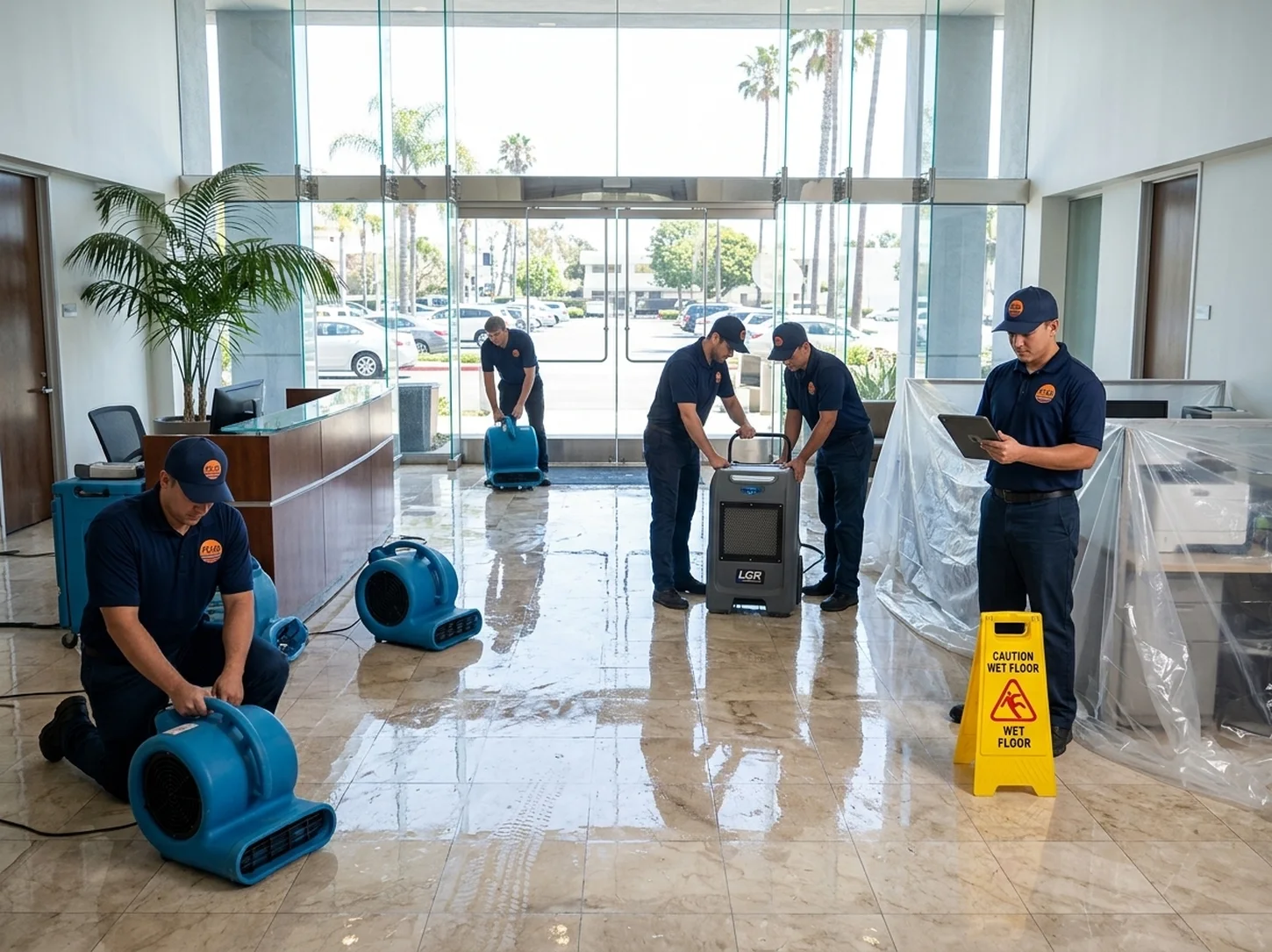
Common Area, Exclusive Use, or Owner — and Who Pays
In a California association, maintenance and repair responsibility is set by Civil Code §4775 unless the governing documents say otherwise. In broad terms the association maintains common area, and the owner maintains the separate interest and, in most cases, exclusive-use common area. Where the water came from usually decides who pays.
We are a restoration contractor, not your association’s counsel, so we do not make that determination and we will not tell a board how to allocate cost. What we can do is establish the facts the determination rests on: where the failure occurred, which assemblies the water crossed, and what damage each unit sustained.
| Where it originated | Typically treated as | What we document |
|---|---|---|
| Roof, exterior envelope, or building drain line | Common area in most CC&Rs | Entry point, travel path through the structure, and damage in every affected unit. |
| Supply line inside a unit, angle stop, appliance | Owner’s separate interest | The failed component, photographs before disturbance, and the spread into neighboring units. |
| Pipe inside a shared demising wall | Frequently disputed | Exact location within the assembly, which side it served, and readings on both sides of the wall. |
| Balcony, patio, or deck drainage | Often exclusive-use common area | Whether failure was in the waterproofing membrane or in owner-installed finishes above it. |
| Water heater in a closet or garage | Usually the owner’s | Age and failure mode where visible, plus the path into common corridors or units below. |
The Buildings We Work In
Our commercial experience is concentrated in multi-family, HOA and condo property, with office and retail alongside it. We are specific about that because a contractor claiming every vertical usually has depth in none.
HOAs & condominiums
Stacked and attached housing where a single failure crosses units. Roughly a decade of our work sits here — the dense attached stock around Laguna Woods Village, Aliso Viejo, Mission Viejo, and the Irvine condo villages. Per-unit documentation, board reporting, and coordination with several owners at once.
Multi-family & rentals
Apartment buildings and single-unit rentals where a landlord is remote and a tenant is on site. Access coordination, tenant notice, and an insurance-ready invoice with documentation the owner can act on without visiting.
Office & professional space
Suites where the real cost is downtime and the contents include electronics and paper records. Containment to keep unaffected areas working, and phased scheduling around business hours.
Retail & small commercial
Storefronts and small units where closing for a week is not survivable. We prioritize getting the trading area usable and phase the rest around opening times.
How a Multi-Unit Response Runs
Six stages. The difference from a residential job is almost entirely in stages two and six — establishing the extent across units, and reporting it in a form several different parties can each use.
Dispatch and Source Control
A person answers 24/7. We talk your on-site staff or building engineer through shutting the source and isolating power while the nearest available crew is routed to you.
- Your manager gets a named contact, not a ticket number
- We ask immediately which units are affected and who has keys
Establishing the Extent Across Units
Moisture mapping does not stop at a unit boundary. We meter through shared walls, ceilings and floors into adjacent units, because water crosses assemblies regardless of who owns which side.
- We will ask for access to units that report no damage — that is deliberate
- Each unit gets its own starting readings and photographs
Extraction and Controlled Removal
Standing water out, then removal of materials that cannot be dried. In occupied buildings this is scheduled around residents and trading where possible, with containment to keep debris and noise contained.
- Corridors and lifts protected before anything is carried out
- Work windows agreed with the manager in advance
Drying, Per Unit
Equipment sized per affected space rather than per building, with daily documented readings in every unit. Equipment placement is recorded by unit so cost can be allocated later without argument.
- Daily logs per unit, not one log for the building
- Equipment leaves each space when that space meets its drying goal
Reporting to the Board or Manager
A consolidated report with per-unit sections: origin, path, affected materials, readings, photographs, and what was removed. Written to be attached to minutes or forwarded to counsel and carriers without editing.
- One document your board can circulate
- Sections separable so each owner can send their own to their carrier
Rebuild Under One License
Reconstruction by the same company, under CSLB #935386. For a manager that means one contract and one point of accountability rather than re-tendering the rebuild once everything is dry.
- Itemized rebuild scope per unit
- Finishes matched across units where a common corridor or shared area is involved
What a Board or Manager Actually Receives
On a multi-unit loss the report is the product. The drying equipment goes away; the documentation is what the association still has when an owner disputes an allocation eighteen months later.
- Origin and path — where the failure occurred and which assemblies the water crossed, with the readings supporting it.
- Per-unit sections — readings, photographs, affected materials, and equipment placement for each unit separately.
- Daily drying logs — by unit, showing the trend to the drying goal and the final verification reading.
- What was removed and why — the line adjusters query most, answered before it is asked.
- Itemized scope — mitigation and rebuild separated, so cost allocation between association and owners is possible.
- A version each owner can use — sections that can be sent individually to different carriers without exposing other owners’ details.
Ask any manager who has been through a stacked-building loss what they wished they had. It is almost never faster drying. It is a record clear enough that the allocation conversation takes one meeting instead of four.
Keeping the Building Working While We Dry It
For a business, closed days usually cost more than the restoration. For an association, displaced residents create pressure no board enjoys. Most of that is avoidable with containment and phasing, if it is planned on day one rather than day four.
How we keep space usable
- Containment around the work area — so the rest of the floor or suite stays in use rather than the whole building shutting.
- Phased scheduling — noisy demolition outside trading or quiet hours; drying equipment runs continuously because it must.
- Protected access routes — corridors, lifts, and entrances covered so residents and customers keep using them.
- Equipment placed to minimize disruption — noise and hoses routed away from occupied and public areas where the drying plan allows.
- Clear notice — residents and staff told what will be noisy and when, which prevents most complaints.
What we will not compromise
- Removing equipment early to reduce noise — an unfinished dry-out becomes a mold remediation, which closes far more of the building for far longer.
- Closing walls before verification — no schedule pressure changes what the meter says.
- Skipping units that report no damage — if the readings say a neighboring unit is wet, it gets dried.
- Working without documenting — speed that produces no record costs the association more later than the days it saved.
What Fails in South OC Commercial and Multi-Family Buildings
Multi-unit buildings fail in predictable places, and the pattern is different from single-family housing because the plumbing runs vertically through shared assemblies.
- Supply-line and angle-stop failures in stacked units — the classic condo loss. A braided connector fails on an upper floor overnight and water finds every unit below it before anyone is awake.
- Water heaters in closets and garages — often original to the building in older associations, and positioned where a rupture drains straight into a shared wall or a corridor.
- Building drain-line backups — shared waste lines that back up into ground-floor units. Usually Category 3 from the moment it starts, which changes the scope immediately.
- Balcony and deck waterproofing failures — common in coastal buildings from Dana Point through Capistrano Beach where membranes take sun and salt air. Water enters the wall below the door threshold.
- Roof and flashing failures over stacked units — one entry point above a three-storey stack affects three owners. See roof leak water damage.
- HVAC condensate lines in shared chases — slow, hidden, and often discovered as an odor complaint rather than a water event.
- Fire-sprinkler discharge — accidental activation delivers a large volume of water very quickly across whatever is beneath it.
What Your Building Engineer or Manager Should Do First
A short list worth keeping with the emergency contacts. The first thirty minutes, handled well by whoever is on site, meaningfully reduces the eventual scope.
Do this
- Isolate the source — unit shutoff, riser, or building main, whichever stops it fastest and safely.
- Cut power to affected circuits — particularly where water is entering units below through light fixtures.
- Photograph before anyone moves anything — origin, standing water, and every affected unit. This is the record the allocation argument later rests on.
- Note the time it was discovered and reported — duration matters for both category escalation and coverage.
- Start collecting access — identify who holds keys for adjacent units before the crew arrives.
- Notify affected residents early — even before you have answers. Silence generates more complaints than bad news does.
Do not do this
- Do not wait for board authorization to start mitigation — the drying clock does not pause for a vote, and delay expands the scope for everyone.
- Do not tell an owner who is at fault — before the origin is documented. It is very hard to walk back.
- Do not let staff enter standing water near live circuits — no piece of building equipment is worth it.
- Do not limit inspection to units that complained — the quiet neighbor is often the wetter one.
- Do not use a household vacuum on water — shock risk, and it will destroy the machine.
- Do not close anything up to make the corridor presentable — a sealed wet assembly is a future remediation.
Standing Vendor Relationships
We act as a standing interior-response vendor for management portfolios and associations across South Orange County. Setting that up before an incident is the single cheapest thing a manager can do to shorten response.
The practical benefit is not a discount. It is that when a riser fails at 2am, the person answering already knows which building you mean, whether it is stacked or garden-style, where the shutoffs are, and who has to be told. That knowledge is normally acquired during the first hour of an emergency, at the worst possible time.
- A direct line for your team — not a general enquiry queue.
- Property familiarity in advance — construction type, shutoff locations, access arrangements, previous losses.
- Reporting to your format — we learn what your board or owner needs before the first job, not after it.
- Storm-season readiness — the winter weeks when every association in the county calls at once are exactly when an existing relationship matters.
Commercial & HOA Questions, Answered
The questions boards, managers, and building owners ask — including the one about who pays.
Water crossed from one condo into another. Who is responsible?
That depends on where the failure originated and what the association’s governing documents say. California Civil Code §4775 sets the default split between association and owner responsibility, but the CC&Rs can modify it. Our job is to document where the water started and travelled so the board can decide from evidence.
Can you work after hours so we do not disrupt residents or trading?
Yes, and for occupied buildings it is often the better plan. Demolition and equipment placement can run outside business hours or resident quiet hours, with drying equipment continuing around the clock because it has to run continuously regardless.
How do you document a loss across multiple units?
Per unit, not per building. Each affected unit gets its own moisture readings, photographs, affected-material list and daily drying log, tied back to the shared source. That is the only format a board, a manager, and several different carriers can all use.
Do you become a preferred vendor for a management portfolio?
We do this for associations and management companies across South Orange County. Your team gets our direct line, we learn the properties and your reporting preferences in advance, and storm-season response is faster because the relationship already exists. Call 949-617-1111 to set that up.
How fast can you respond to a commercial emergency?
We run live 24/7 dispatch and route the nearest available crew from our Laguna Hills yard, which is central to Irvine, Aliso Viejo, Mission Viejo and Lake Forest. Call 949-617-1111 and we will start guiding your on-site staff through damage control while the crew is en route.
Can you keep part of the building open while you work?
Usually yes. Containment isolates the work area so the rest of the premises stays usable, and phasing lets a business keep trading in the unaffected portion. Tell us early what has to stay open and we will build the plan around it.
Do you handle the rebuild as well as the drying?
Yes. PCH holds California contractor license CSLB #935386, so mitigation and reconstruction are one company and one scope. For a board or manager that means one point of contact and no gap between the drying contractor finishing and a builder starting.
What about tenant communication?
We coordinate access, work windows, and equipment placement with the manager rather than negotiating separately with each resident. Consistent notice about noise, equipment and timelines prevents most of the complaints that make multi-unit jobs difficult.
Do you work in healthcare facilities?
No. Healthcare environments require ICRA infection-control containment, which is a specialized capability we do not claim to hold. Our commercial experience is HOA, condo, multi-family, office, and retail property. We will say so plainly rather than take work we are not the right firm for.
Why does a shared-wall loss cost more than the same leak in a house?
Because water crosses assemblies that belong to different parties, so the job needs separate documentation per unit, coordinated access across several owners, and often phased work around occupancy. The drying itself is comparable; the coordination is what differs.
Managing a Loss Across Multiple Units?
We answer 24/7, document per unit from the first hour, and rebuild under one license — so your board gets one contact and one record.