
Mold Inspection in Irvine & South OC
Musty smell, a past leak, or a stain nobody can explain? We map the moisture with meters and thermal imaging, find the source, and give you a written report — with independent third-party lab testing only when sampling would actually change the decision. If you do not need remediation, we will say so.
- Independent Third-Party Lab Testing
- Thermal Imaging & Moisture Mapping
- Written Report You Can Hand Over
- Licensed CA Contractor — CSLB #935386
What a Mold Inspection Is — and Is Not
A mold inspection is a diagnostic visit. It finds where moisture is, where it came from, and whether there is growth — using visual assessment, moisture meters, and thermal imaging. It is not remediation, and it is not automatically a lab test. Sampling is added only when a number would actually change what happens next.
The inspection is really about water. Mold is a symptom. Find the moisture and you have found the cause, the extent, and what has to change to stop it recurring.
Sampling goes to an independent lab. The company that would profit from removal should not be the one grading how much removal you need.
Sometimes you need nobody. The EPA sets a rough do-it-yourself threshold around 10 square feet on hard surfaces. We will tell you when you are under it.
Recent leak? Skip the test. If water is still active, drying matters more than sampling — the EPA advises drying within 24–48 hours to prevent growth in the first place.
Testing is not the same as inspecting
These two get sold as one thing and they are not. An inspection is somebody competent walking your property with instruments, forming a judgment about where water is and what it has done. A test is a sample sent to a laboratory that reports what was in the air or on a surface at one moment, in one spot.
The inspection is almost always the valuable half. A lab result telling you spores are present, without telling you where the water came from, is a number you cannot act on. That is why we lead with moisture mapping and treat sampling as a tool we reach for when there is a specific question it can answer.
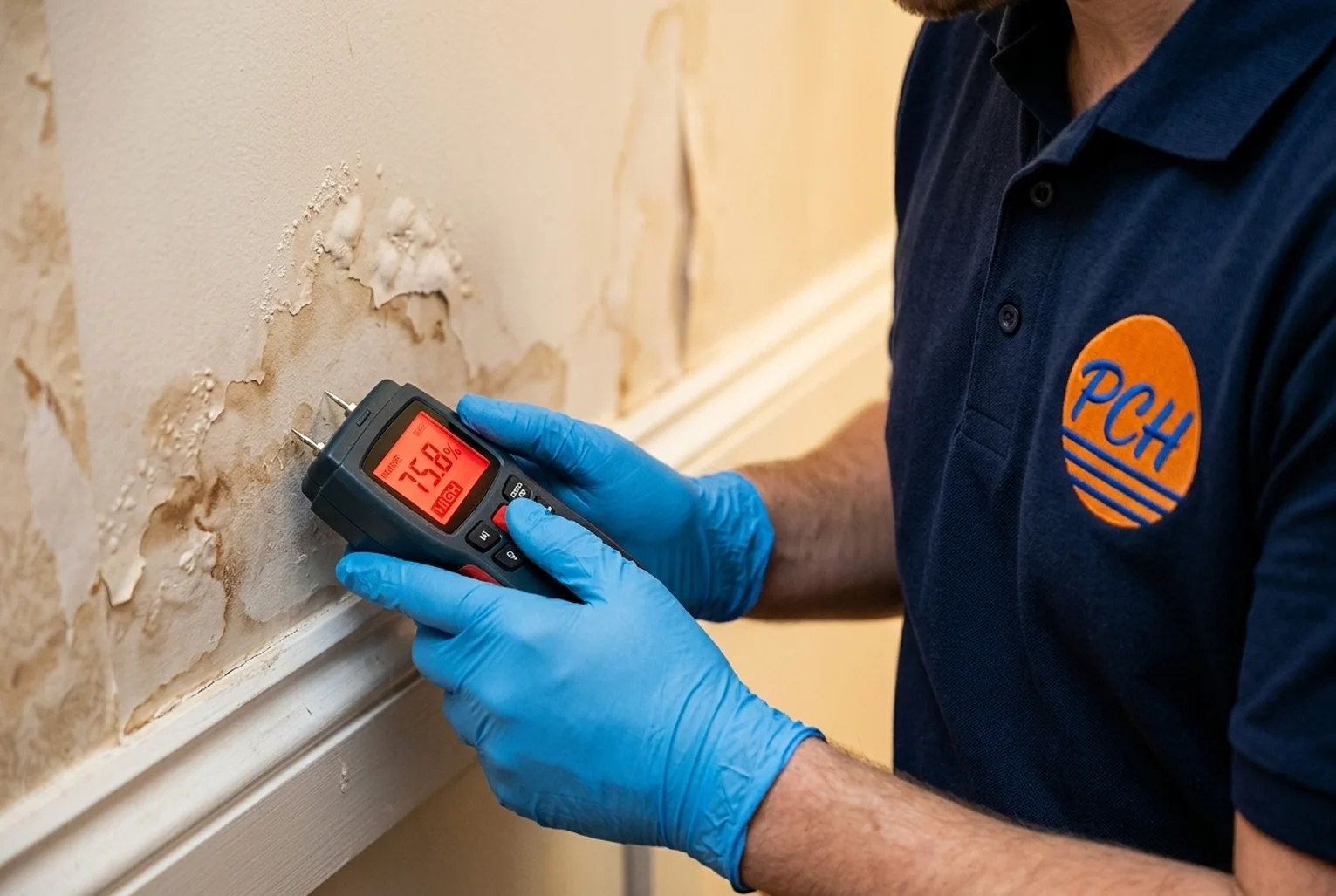
When Testing Is Worth It, and When It Is Money Wasted
Most people who call asking for a mold test do not need one. Testing is worth paying for when a number will change a decision — a purchase, a claim, a board vote, or a medical conversation. It is not worth paying for to confirm what you can already see.
Testing is worth it when
- You can smell it but cannot find it — a musty odor with no visible source means something is happening inside an assembly.
- Someone in the home has symptoms — particularly asthma, mold allergy, or a compromised immune system, where a documented finding supports a medical conversation.
- You are buying or selling — a third-party result is evidence in a negotiation; your opinion of the smell is not.
- An HOA board or landlord needs documentation — shared-wall disputes get resolved on paper, not on assertions.
- An insurer has asked for it — sometimes a carrier wants lab confirmation before authorizing scope.
- Remediation is finished — clearance testing is the one case where we insist, and it must be independent.
Testing is usually a waste when
- You can already see it and know the cause — a lab confirming visible mold under a leaking sink changes nothing about the work.
- The leak is active right now — stop the water and dry the structure; sampling a wet building tells you it is wet.
- You want to know if it is “toxic” — species does not reliably predict how a given person reacts, and the remediation is the same either way.
- You bought a home test kit — a settle plate grows something from almost any indoor air, with no baseline to compare against.
- A contractor offered a free test — free testing performed by the company that wants the removal work is marketing, not diagnostics.
What Happens During the Inspection
Five stages, typically 60 to 120 minutes on site depending on the size of the property and how much of it is in question. You are welcome to follow us around — most people learn more that way than from the report.
The Conversation First
Before instruments come out, we ask what you noticed and when. A smell that appears after rain points somewhere different from a smell that is constant, and a stain that grew over months points somewhere different again.
- Tell us about any past leak, claim, or repair, even years ago
- Tell us if anyone in the home has asthma, allergies, or is immune-compromised
Visual Assessment
We look where water goes rather than where it shows: under sinks, behind toilets, around the water heater, at window heads and door thresholds, at ceiling penetrations, and around HVAC equipment and its condensate line.
- You will see us in cupboards, closets and the garage, not just the room you called about
- Staining, warping, bubbling paint and efflorescence all get photographed
Moisture Mapping
Pinless meters scan broad areas without marking finishes; pin meters confirm moisture content at depth where a reading looks elevated. We work outward from the suspected source until readings return to normal, which is how the extent gets defined.
- You will see us reading walls in rooms that seem fine — that establishes the normal baseline
- Elevated readings get mapped, not just noted
Thermal Imaging and Cavity Inspection
A thermal camera shows temperature differences that often indicate evaporative cooling from moisture behind a surface. Where a cavity needs confirming, a borescope through a small hole shows the inside without opening the wall.
- Thermal imaging suggests where moisture is; the meter confirms it — we use both
- Any inspection opening is discussed with you before it is made
Findings, and Sampling Only If Justified
We tell you what we found before we leave. If sampling would genuinely change the decision, we explain what it would test and why, and coordinate it through an independent third-party lab. If it would not, we say so.
- You get a verbal summary on the day and a written report after
- Any sampling is quoted separately, so you can decline it
The Instruments, and What Each One Can Actually Tell You
Every instrument on an inspection has a specific limit as well as a use. Knowing the limit is what separates a diagnosis from a guess, so here is what each tool does and does not prove.
| Instrument | What it tells you | What it cannot tell you |
|---|---|---|
| Pinless moisture meter | Scans broad areas fast for elevated moisture, without marking the finish. | Exact depth, and it can be fooled by metal, foil-backed insulation, or dense backing. |
| Pin moisture meter | Moisture content at a known depth in a specific material — the number the drying goal uses. | Anything about the area it did not touch; it leaves two small holes. |
| Thermal imaging camera | Temperature anomalies, which often reveal evaporative cooling from moisture behind a surface. | It does not see moisture or mold. It sees temperature, which is why every finding is confirmed with a meter. |
| Thermo-hygrometer | Air temperature, relative humidity, and dew point — whether conditions favor condensation. | Where the moisture is in the structure. |
| Borescope | Direct visual confirmation inside a wall or ceiling cavity through a small hole. | Only shows what is in its line of sight; it is a spot check, not a survey. |
| Independent lab sampling | What was present in that sample, compared against an outdoor baseline and unaffected indoor area. | Where the water came from, how long it has been there, or how you will personally react. |
The Types of Sample, and What Each Answers
If sampling is justified, the type has to match the question. Air sampling asks what is airborne right now; surface sampling asks what is growing on that spot. They answer different things and are not interchangeable.
Air sampling
Draws a measured volume of air through a collection cassette, analyzed and compared against a simultaneous outdoor sample and an unaffected indoor area. It is the standard method for clearance testing, and the only one where the outdoor baseline is genuinely essential — without it, the indoor number means nothing.
Surface sampling
A tape lift or swab from a specific spot, confirming whether visible growth is mold and broadly what type. Useful for documenting a finding on a purchase or a claim. It says nothing about the air in the room or about anywhere it was not taken.
Cavity sampling
Sampling from inside a wall or ceiling assembly through a small port. Reserved for when there is a strong reason to believe growth is enclosed and inaccessible, and the answer would change whether the assembly gets opened.
Whichever is used, the sample goes to an independent third-party laboratory. We do not analyze samples ourselves and we do not interpret a result into a bigger scope of work for us. The lab reports; you decide.
What Homeowners Notice First
Hidden mold rarely announces itself visually. In practice it shows up as a smell, a symptom, or a small building change that seems unrelated — and the earlier one of these is investigated, the smaller the eventual job.
- A musty smell that comes and goes — often stronger in the morning, after rain, or when the air conditioning starts. Odor is the single most reliable early indicator of hidden growth.
- Symptoms that improve when you leave the house — a pattern worth mentioning to your doctor, and worth investigating in the building.
- Paint bubbling, blistering, or a hairline crack in a straight line — usually the surface reacting to moisture behind it.
- Baseboard pulling away, or a soft patch at the bottom of a wall — classic slab-on-grade wicking, common in Irvine’s older villages.
- A stain that reappears after being painted over — the water is still arriving. Paint never fixed anything.
- Warped or cupping flooring with no obvious spill — moisture arriving from underneath, often a slab leak.
- Condensation on windows or a bathroom that stays damp for hours — a ventilation problem that becomes a mold problem over a coastal winter.
- An HVAC smell that returns each cooling season — frequently a blocked condensate line wetting a cavity or the air handler itself.
Homeowners, Buyers, HOA Boards, and Property Managers
The inspection is the same; what the report has to do is different. A homeowner needs to know what to fix. A buyer needs leverage. A board needs a defensible record. We write for whoever is going to have to act on it.
Homeowners and buyers
You want a plain answer: is there a problem, how big, what caused it, what does it cost to put right. For a purchase, you also want something a seller’s agent cannot wave away.
- Findings in plain language, with photographs
- The suspected source named, not just the symptom
- Independent lab results where sampling was justified
- An honest view on urgency — including “this can wait”
HOA boards, managers, and landlords
Roughly a decade of our work has been HOA and condo water damage, where the hard question is rarely technical. It is whether the moisture originated in common area or inside the unit, because that determines who pays.
- Per-unit documentation with readings and photographs by location
- Findings framed against California Civil Code §4775 maintenance-responsibility questions
- Reports a board can attach to minutes or send to counsel
- Coordination with adjacent units when a cavity is shared
What We Look For in South Orange County Homes
Local building stock narrows the search considerably. Knowing the era and construction of a property tells an inspector where to look before walking in the door.
- 1970s–80s slab-on-grade villages — Woodbridge, Northwood, University Park and Turtle Rock were built on slab with copper supply lines. We check baseboards and the bottom of walls first, because a slab leak wicks upward and shows there long before it shows anywhere else.
- HVAC condensate lines — the most common hidden source we find. A blocked drain wets a ceiling or wall cavity quietly for months, which is why the air handler and its drain path get inspected even when the complaint is in another room.
- Coastal marine-layer humidity — in Corona del Mar, Newport Coast, Dana Point and Capistrano Beach, persistent morning damp plus a poorly ventilated bathroom or closet grows surface mold with no leak at all. That is a ventilation fix, not a remediation.
- Condo and shared-wall stock — around Laguna Woods Village, Aliso Viejo and Mission Viejo, moisture crosses between units through shared cavities. Inspecting only the unit that complained often misses the source.
- Wind-driven winter rain — our rainfall arrives in short, intense storms that drive water at window heads and roof penetrations. See roof leak water damage.
What You Actually Receive
A written report covering what we inspected, what we found, what we measured, what we think caused it, and what we recommend — including when the recommendation is to do nothing.
- Scope of the inspection — which areas were assessed, and importantly which were not and why.
- Moisture readings — by location and material, including the unaffected baseline readings for comparison.
- Photographs — of findings, staining, and any inspection openings made.
- Suspected source — named, with the reasoning, since fixing the source is the only permanent solution.
- Independent lab results — attached in full where sampling was performed, not summarized by us.
- Recommended next steps — in order of priority, with a clear line between what is urgent and what is worth monitoring.
If the report recommends remediation and you would rather another contractor do it, that is genuinely fine — the report is yours and it is written to be usable by anyone. We would rather be the company that found it honestly than the company that only found what it wanted to sell.
Mold Inspection Questions, Answered
Including the one most companies avoid: quite often, you do not need the test you called to book.
Do I actually need a mold test?
Often not. If mold is visible and the water source is obvious, testing usually adds cost without changing what has to be done. Testing earns its place when the problem is hidden, when occupants have symptoms, or when a buyer, seller, board or insurer needs documentation.
Why should the lab be independent of the remediator?
Because a company that profits from removal should not be the one deciding how much removal you need, or certifying its own result afterward. We coordinate sampling through an independent third-party lab so the finding stands on its own.
Are home mold test kits any use?
Very little. A settle plate will grow something from almost any indoor air, because mold spores are normally present everywhere. Without an outdoor baseline, a trained sampling method and a lab comparison, a positive result tells you almost nothing actionable.
What does a mold inspection actually include?
A visual assessment of the areas of concern, moisture mapping with pin and pinless meters, thermal imaging to find temperature differences that suggest hidden moisture, borescope inspection of a cavity where justified, and a written report of findings with recommended next steps.
Can you find mold inside a wall without opening it?
We can find the moisture that would support it. Thermal imaging shows temperature anomalies and meters confirm elevated moisture behind a surface. Confirming actual growth needs either a borescope through a small hole or an inspection opening, which we discuss with you first.
I smell something musty but cannot see anything. What now?
That is the most common reason people call us. A musty odor without visible growth usually means moisture inside an assembly — a wall cavity, under flooring, in a ceiling above a bathroom, or around an HVAC condensate line. Moisture mapping is the right first step, not sampling.
Do I need an inspection before buying a home in Irvine?
It is worth it when the property is a 1970s or 80s slab-on-grade home with original copper plumbing, when there is any history of a leak or claim, or when a general home inspection has flagged staining or elevated moisture. Otherwise a standard home inspection usually covers it.
Will you tell me I need remediation when I do not?
We try hard not to, which is why we tell you when a small patch on a hard surface is a homeowner cleanup. The EPA sets a rough do-it-yourself threshold around 10 square feet on non-porous surfaces. Below that, with an obvious cause, you often do not need a contractor at all.
What does the report include, and who is it for?
Findings, moisture readings, photographs, the suspected source, and recommended next steps in plain language. It is written so a homeowner can read it and an HOA board, adjuster, buyer or seller can act on it without needing a translation.
Is post-remediation clearance the same as an inspection?
No. An inspection asks whether there is a problem and where. Clearance, or post-remediation verification, asks whether completed work succeeded, and is sampled before containment comes down — see mold remediation. Both should be independent of whoever performs the removal.
Smell Something You Cannot Find?
We will map the moisture, name the source, and tell you honestly whether you need remediation, a ventilation fix, or nothing at all.